Shingeki no Kyojin, también conocido como Attack on Titan, es una obra que ha cautivado a audiencias de todo el mundo por su intrincada trama y su profundo desarrollo de personajes. Más allá de la lucha contra los titanes, la serie presenta una compleja estructura militar con divisiones que poseen sus propios y significativos emblemas. Descubrir el significado de estos símbolos nos ofrece una visión más profunda del mundo creado por Hajime Isayama.
La obra de Hajime Isayama cuenta con un montón de elementos destacables, así como una historia repleta de misterios que esperan a ser revelados. El autor ha conseguido crear un mundo que se siente vivo, explicando y desarrollando todas las organizaciones que lo conforman. Pero si has estado pendiente de la historia, sabrás que existen varios símbolos que representan algunas organizaciones estructurales de Paradis. Y si quieres conocer más al respecto, has llegado al sitio correcto, pues hemos preparado este post para contarte qué significa cada una de estas figuras.
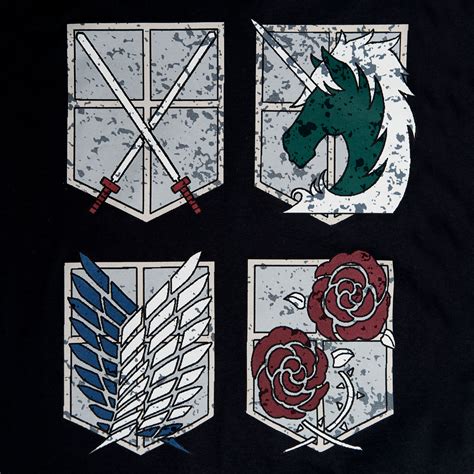
Las Divisiones Militares de Paradis
Dentro de las murallas de la isla Paradis, la humanidad se organiza en diversas ramas militares, cada una con un rol específico y un emblema distintivo que refleja su propósito.
Las Tropas de Guarnición
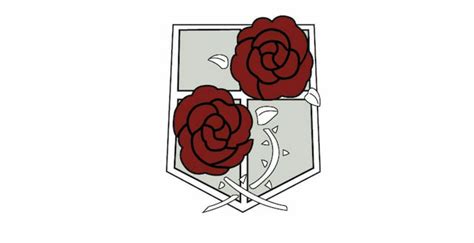
Las Tropas de Guarnición son una de las divisiones militares creadas para mantener el orden dentro de las murallas en el mundo de Shingeki no Kyojin. Por lo general, esta es la elección de la mayoría de los soldados cuando deben unirse a una división, pues otras como el Cuerpo de Exploración supone un gran riesgo, mientras que la Policía Militar ofrece cupos muy limitados. Las Tropas de Guarnición suelen tener contacto directo con los Titanes, pues su puesto de trabajo suele estar en la parte superior de las murallas. Debido a esto también tienen conocimientos en el uso y manejo de los cañones, el control de multitudes para evacuaciones y su enfoque de combate es bastante defensivo. En lo que respecta al deber de esta división militar, debes saber que su misión es proteger las murallas y conservar el orden en las murallas, menos en la Muralla Sina. Estos equipos son los que arman los cañones en las paredes y pueden colaborar en la evacuación de civiles en caso de un ataque. Y es precisamente su misión lo que significa el símbolo de su escudo, conformado por rosas, las cuales suelen ser usadas para representar a los mártires que se sacrifican por los demás, en las culturas cristianas.
La Policía Militar
La Policía Militar es otra de las divisiones militares que operan dentro de las murallas de la isla Paradis. Su principal misión es proteger y servir al rey de turno, así como mantener el orden en esta muralla. Por lo general, solo se ofrecen 10 cupos de ingreso a la Policía Militar, así que solo aquellos con las mejores calificaciones pueden unirse a esta división. Este es un puesto bastante importante y cómodo, pues los miembros de la división pueden vivir en el interior de esta muralla. Sin embargo, también es una de las organizaciones más corruptas que se ha mostrado en Shingeki no Kyojin, pues carecen de control. Con respecto al funcionamiento y conducta de la Policía Militar, debes saber que estos se dividían en varios grupos, en los que la mayoría se centraba en el control de las personas y mantener a los civiles a raya, así como compartir la información necesaria con los medios. Mientras que unos pocos se encargaban de acciones oscuras como gobernar en las sombras. El escudo de la Policía Militar está conformado por un unicornio, lo que hace énfasis en su misión y compromiso con la transparencia de acciones y estar libres de corrupciones. Sin embargo, esto resulta bastante irónico, pues, como hemos mencionado, son una división que ha estado corrompida.
El Cuerpo de Exploración
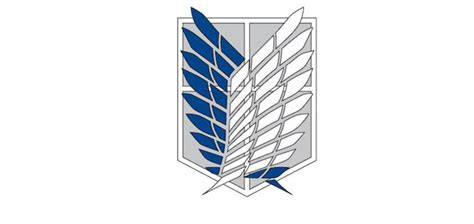
El Cuerpo de Exploración conforma una de las divisiones del ejército militar de la isla Paradis. A diferencia del resto, este grupo se encarga de salir de la seguridad de las murallas para luchar directamente con los Titanes. Evidentemente, esto significa que los miembros del Cuerpo de Exploración están muy expuestos a ser asesinados por estas criaturas de gran tamaño. Además, una de las características que los ha definido durante años es que han fracasado en sus expediciones fuera de las murallas. Aunque siempre se ha creído que una victoria de este equipo sería un triunfo de todo el mundo. Sin embargo, después se confirmaría que hay otras naciones en esta obra. La misión de esta división es acabar con la amenaza de los Titanes para liberar a la humanidad de estos monstruos. Pero no es todo, pues cuando la Muralla María fue destruida, el Cuerpo de Exploración tuvo que trabajar como parte del equipo de abastecimiento de suministros en el interior. En la serie, el Cuerpo de Exploración es el principal protagonista, pues es la división a la que se unen Eren, Mikasa, Armin y sus amigos, ya que tienen la misión personal de acabar con esta plaga. Y estos personajes pasan muchos años (como miembros de este grupo). Se sabe que el escudo del Cuerpo de Exploración es representado por unas alas, las cuales simbolizan la protección de este equipo sobre la humanidad. A menudo, este símbolo es asociado con protección divina.
Las Tropas de Reclutas
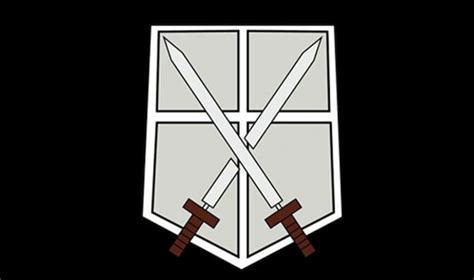
Si bien es cierto que las Tropas de Reclutas no son una división de la fuerza militar dentro de las murallas, sí juegan un papel importante en la franquicia, pues es la gran prueba que deben superar todos los aspirantes a unirse a cualquiera de las divisiones. El escudo de las Tropas de Reclutas está conformado por un par de espadas cruzadas, lo que podría simbolizar el gran desafío que experimentan todos estos aspirantes y lo difícil que es el entrenamiento para poder graduarse y unirse a una de las divisiones. Dependiendo del rendimiento que tengan los aspirantes en estas pruebas, obtendrán calificaciones.
El Mundo de Attack on Titan
Attack on Titan (Japanese: 進撃の巨人, Hepburn: Shingeki no Kyojin; lit. 'The Advancing Giant') is a Japanese manga series written and illustrated by Hajime Isayama. Set in a world where humanity is forced to live in cities surrounded by three enormous walls that protect them from gigantic man-eating humanoids referred to as Titans, the story follows Eren Yeager, an adolescent boy who vows to exterminate the Titans after they bring about the destruction of his hometown and the death of his mother. An anime television series was produced by Wit Studio (seasons 1-3) and MAPPA (season 4). A 25-episode first season was broadcast from April to September 2013, followed by a 12-episode second season broadcast from April to June 2017. A 22-episode third season was broadcast in two parts, with the first 12 episodes airing from July to October 2018 and the last 10 episodes airing from April to July 2019. A fourth and final season premiered in December 2020, airing 16 episodes in its first part. Attack on Titan has been met with critical and commercial success. By November 2023, the manga had over 140 million copies in circulation, making it one of the best-selling manga series of all time.
Attack on Titan centers on a civilization within three circular walls. According to local belief, it is the last surviving vestige of human civilization. Its inhabitants, known as Eldians, have been led to believe that, over one hundred years ago, humanity was driven to the brink of extinction by the emergence of humanoid giants called Titans, which attack and eat humans on sight. The last remnants of humanity retreated behind three concentric walls and enjoyed roughly a century of peace. Within the walls, residents are strongly discouraged from venturing outside. To combat Titans, the country's military employs Vertical Maneuvering Equipment (VME), also known as Omni-Directional Maneuvering Gear (ODM gear), a set of waist-mounted grappling hooks and gas-powered propulsion that enables mobility in three dimensions.
Titans are classified into several types. Pure Titans are the weakest and most common, whose predictable behavior makes them easier to kill. Abnormal Titans are Pure Titans whose behavior is less predictable, making them harder to combat. The Nine Titans, also known as Titan Shifters, are the Attack, Colossal, Armored, Female, Beast, Jaw, Cart, War Hammer, and Founding Titans. They are the strongest Titans; each is able to shift back and forth between human and Titan form to access their Titan's abilities. Pure Titans are created by injecting Eldians with Titan spinal fluid. If a Pure Titan consumes a human who possesses one of the Nine Titans, that Eldian will revert to human form and gain that Shifter's powers, whereupon they are cursed to live only 13 more years. If the powers are not inherited by another Eldian before the holder's death, they are passed to an Eldian baby born shortly thereafter, regardless of distance or blood relations.
Eren Yeager is a boy who lives in the town of Shiganshina, located on the outermost of three circular walls which protect their inhabitants from Titans. In the year 845, the first wall, Wall Maria, is breached by two new types of Titans, the Colossal Titan and the Armored Titan. During the incident, Eren's mother is eaten by a grinning Titan while Eren escapes. Five years after Shiganshina's fall, the Colossal Titan attacks the city of Trost, located in the second innermost wall, Wall Rose. Eren helps to successfully defend the city after he discovers a mysterious ability to turn himself into a sentient Attack Titan. Additionally, he regains memories of his father Grisha Yeager giving him this ability shortly after the fall of Wall Maria, and telling him that the truth about their world can be found in their basement in Shiganshina. These events draw the attention of the Survey Corps and their commander, Erwin Smith, who intend to use his power to reclaim Wall Maria and reach the Yeagers' basement.
Eren, Mikasa, and Armin are transferred to the Special Operations Squad, under the care of Levi Ackerman and Hange Zoë. During an expedition into the forest between the walls, Eren and his companions encounter a sentient Female Titan, who is later revealed to be their fellow military comrade Annie Leonhart. With help from his friends, Eren fights and defeats Annie, who encases herself in crystal and is put in custody. Shortly thereafter, Pure Titans mysteriously appear within Wall Rose with no evidence of how they got in, accompanied by the sentient Beast Titan. Ymir, one of the new Survey Corps graduates, reveals that she can transform into the sentient Jaw Titan, while Ymir's close friend Krista Lenz reveals herself as Historia Reiss, a member of the royal family. Two other members of the Survey Corps, Reiner Braun and Bertholt Hoover, reveal themselves as the Armored and Colossal Titan respectively. They attempt to kidnap Eren and Ymir, but fail. In the ensuing battle, Eren discovers another power within himself called "the Coordinate", that allows him to control other Titans, which he uses to kill the grinning Titan and send a horde of Pure Titans to attack Reiner and Bertholt. This forces the two to escape, and Ymir willingly flees with them, offering herself as a sacrifice to prevent Historia from being targeted by the enemy.
In the aftermath of these events, it is determined that the Pure Titans who suddenly appeared within Wall Rose were the inhabitants of various villages within Wall Rose, who had in some way been transformed into Titans. Eren and his friends join Levi Squad while the Survey Corps is targeted by the Military Police led by Kenny Ackerman, Levi's uncle. In the occasion, they discover that by transforming into a Pure Titan via a serum made of Titan spinal fluid and eating another Titan shifter, a person can inherit its abilities, and that Historia and her father, Rod Reiss, are the only surviving members of the royal bloodline. Rod kidnaps Eren because he is in possession of the Founding Titan, obtained by his father Grisha upon eating Frieda Reiss (Historia's half-sister), and by Eren through eating his father. Rod tries to convince Historia to allow herself to be transformed into a Titan, so she can eat Eren and regain the Founder's power.
Having resolved the political unrest, the Survey Corps lead a successful operation to recapture Shiganshina, fighting the Beast, Colossal, Armored, and Cart Titans but suffering massive casualties, wherein Erwin dies in a suicide run against the Beast Titan, and Armin gains ownership of the Colossal Titan when Levi injects him with a serum given by Kenny, causing Armin to eat Bertholt. Eren and his companions return to his childhood home, where they discover the truth of their world: they are actually Eldians, sworn enemies of the conquering Marleyans who were enclosed within the walls after the original King Karl Fritz fled from the war. They are not the last humans as they were told, but rather an enclosed sect of Eldians on an isolated island called Paradis. Because they are "Subjects of Ymir" who can be turned into Titans by being injected with Titan spinal fluid, the Eldians continue to be oppressed by Marley.
Three years later, the Survey Corps launch an attack against the Marleyan capital of Liberio, orchestrated by Eren and his half-brother Zeke, who is the owner of the Beast Titan. Eren kills Willy Tybur, an Eldian who (along with his family) had been controlling Marley from the shadows and gains ownership of the War Hammer Titan after eating its previous owner, Willy's sister Lara. Eren is imprisoned for acting against orders but escapes with a faction of extremist Paradis soldiers called the Yeagerists. Zeke is kept in Levi's custody but manages to escape, severely injuring but not killing him. Marley's air fleet, led by Reiner, launch an invasion of Paradis, and chaos breaks out in the ensuing battle. Eren and Zeke reunite, which leads them to the Paths-a series of atemporal gateways connecting all Eldians through time and space. There, they meet the consciousness of Ymir Fritz-the original Titan-whose tortured past led to her imprisonment within the Paths for thousands of years. The Survey Corps ally with the remaining Marleyan forces, including Reiner and a newly freed Annie, to stop Eren. They defeat the Yeagerists before confronting him, though many are killed, including Hange. Levi kills Zeke and Mikasa kills Eren, which causes the mysterious creature that is the source of all Titans' powers to die and the power of the Titans to vanish, reverting all Titans to human form, and stripping the Titan Shifters of their powers, thereby freeing all Eldians from the curse. His death also releases memory blocks that he put on his friends, revealing that what transpired was part of Eren's plan to spare twenty percent of humanity, with Armin, Levi, Mikasa, and the others being recognized as heroes in the eyes of the world for killing him and stopping the Rumbling.
Three years later, as Paradis and the rest of the world rebuilds, Armin and his allies begin peace negotiations led by Queen Historia. Mikasa buries Eren underneath a tree on a hill near Shiganshina District. The tree grows over time to resemble the one where the organism that granted Ymir her Titan power lived. An unspecified amount of time after Mikasa's death from old age, a modernized Shiganshina is reduced to rubble in a war.
La FILOSOFÍA de ATTACK ON TITAN - Análisis
Hajime Isayama created a 65-page one-shot version of Attack on Titan in 2006. Originally, he offered his work to the Weekly Shōnen Jump department at Shueisha, where the editor of the department asked him to modify a few details in the story and artwork, which Isayama refused. He then brought the manga to the Weekly Shōnen Magazine department at Kodansha. Before serialization began in 2009, he had already thought of ideas for plot twists, although they were fleshed out as the series progressed. Isayama initially based the scenery in the manga on that of his hometown of Hita, Ōita, which is surrounded by mountains. While working at an internet cafe, Isayama encountered a drunken customer who grabbed him by the collar. Isayama estimated his basic monthly timeline as one week to storyboard and three weeks to actually draw the chapter. The story was planned out in advance, which involved marking down which collected volumes a specific "truth" would be revealed. In September 2013, Isayama stated that he was aiming to end the series in 20 volumes. Originally, he planned to give the series a tragic conclusion similar to that of the film adaptation of Stephen King's The Mist, where every character dies.
Attack on Titan is written and illustrated by Hajime Isayama. In North America, the series was published in English by Kodansha USA. A chibi parody spin-off based on the series, titled Attack on Titan: Junior High (進撃!巨人中学校, Shingeki! Kyojin Chūgakkō) and written by Saki Nakagawa, began serialization in Bessatsu Shōnen Magazine's May 2012 issue. It follows the main characters as they battle the Titans while in junior high school. Another manga series based on the prequel light novel series Attack on Titan: Before the Fall started serialization in Kodansha's Monthly Shōnen Sirius in August 2013, illustrated by Satoshi Shiki. An additional spin-off based on the No Regrets visual novel was serialized in the manga magazine Aria, titled Attack on Titan: No Regrets (進撃の巨人 悔いなき選択, Shingeki no Kyojin: Kuinaki Sentaku). It was written by Gun Snark and illustrated by Hikaru Suruga.
A light novel series titled Attack on Titan: Before the Fall (進撃の巨人 Before the Fall), written by Ryō Suzukaze and illustrated by Thores Shibamoto, began on April 1, 2011. Its story is set before the events of the manga and it was published by Kodansha in three volumes. The first tells the story of Angel, the blacksmith who develops the first prototypes of the Vertical Maneuvering Equipment, and the following two follow a young man who was found as a baby in the stomach of a Titan. A second light novel series called Attack on Titan: Harsh Mistress of the City (進撃の巨人 隔絶都市の女王, Shingeki no Kyojin Kakuzetsu Toshi no Joō), written by Ryō Kawakami and illustrated by Range Murata, was published between August 1, 2014, and May 1, 2015. Vertical released the novels in North America in 2014 and 2015.
An anime television series based on the manga was produced by Wit Studio and directed by Tetsurō Araki. The first season aired between April 7, 2013, and September 29, 2013, originally on Mainichi Broadcasting System (MBS). The second and the third season, directed by Masashi Koizuka, first aired from April 1 to June 17, 2017, and from July 23, 2018, to July 1, 2019, respectively on MBS and NHK General TV. Upon the airing of the final episode of the third season on July 1, 2019, it was announced that the fourth and final season of the anime series was scheduled for release in Fall 2020 on NHK General. On September 23, 2020, NHK listed the final season on their broadcasting schedule. Other Attack on Titan-related manga or light novels were also adapted into anime. Two original animation DVD (OAD) episodes, based on the Attack on Titan: No Regrets prequel manga, were bundled with the 15th and 16th volumes of the main series, released on December 9, 2014, and April 9, 2015, respectively. An anime television adaptation of Attack on Titan: Junior High began airing in October 2015.
There have been four video game adaptations of Attack on Titan developed by Nitroplus staffers in collaboration with Production I.G. Nitroplus clarified that the studio as a company was not involved in the Attack on Titan Blu-ray Disc games, while individual staffers are. The games are visual novels and were included in the first copies of the third and sixth Blu-ray Disc volumes of the anime. The games cover spin-off stories about the characters of Attack on Titan. The third Blu-ray volume was released on September 18 with Seko's Lost in the Cruel World visual novel about Mikasa, and a preview of Gun Snark's No Regrets (悔いなき選択, Kuinaki Sentaku; lit. An action game, titled Attack on Titan: Humanity in Chains (進撃の巨人 ~反撃の翼~, Shingeki no Kyojin ~Hangeki no Tsubasa~; subtitle lit. A smartphone social game, titled Attack on Titan: Howl Toward Freedom (Shingeki no Kyojin ~Jiyū e no Hōkō~) is in development by Mobage for iOS and Android platforms. In the game, players play as a character who has been exiled from Wall Rose. Attack on Titan: Escape from Certain Death was announced to be in development for the Nintendo 3DS in Famitsu magazine in October 2016. An Attack on Titan mobile game was announced for release on iOS and Android devices at the end of 2016 but was later delayed. In May 2018, it was announced that the mobile game has been titled Attack on Titan: Assault. Attack on Titan: Tactics was announced on April 18, 2019, a...
Temas y Paralelismos Históricos
Attack on Titan distinguishes itself from other fictional stories by delving into various serious and real themes. Under Marley's oppressive rule, Eldians within their borders faced severe consequences for even minor misdemeanors, relegating them to a status akin to second-class citizens. On that decisive day, Marleyan soldiers unjustly and ruthlessly punished Grisha for his actions. Despite the pure and innocent intentions behind their outing, they subjected the boy to a brutal beating and tragically took his sister's life. This mistreatment draws historical parallels, notably to the fascist regime of Nazi Germany, where even a simple joke or criticism about the government often resulted in severe punishments, reflecting the tyrannical actions witnessed under Marley's rule. Similar to Marley, the Nazi authorities exhibited a comparable disdain for dissent. The Marleyan schools and families ingrained a strong bias in their children, fostering a collective mindset that championed their nation. These children were subjected to the injection of hateful thoughts, shaping their perspectives to view Eldians as inferior beings, or sometimes as non-humans entirely (often referring to Eldians as "Devils"). This mentality and imposition of beliefs draw strong parallels to the era of Nazi Germany, a historical period that heavily influences Hajime Isayama's narrative.
Every Eldian within Marley's borders was required to wear an armband, a visual marker of their nationality. To maintain the purity of Marleyan blood, any intimate or similar relationships between Marleyans and Eldians were strictly prohibited, with severe consequences awaiting those caught in such associations. Much like the Marleyans in Attack on Titan, the Nazi German government embraced similar principles of segregating peoples, notably forcing the Jewish population into ghettos. Nazi Germany ardently propagated the belief in the innate superiority of their nation and Aryan peoples over all others, implementing cruel policies that systematically oppressed the Jewish population. Not every Eldian in Marley faced persecution; a select few enjoyed a higher status. Within the Titan-possessing community, there were two distinct groups. The first comprised soldiers like Reiner and Falco, who served in the military. The second, exemplified by the Tybur Family, held an elevated status. Similarly, during Nazi Germany, certain Jewish individuals were granted exemptions or privileges in exchange for collaboration or specialized services to the regime.
Eren, shaped by a tumultuous childhood and oppressive living conditions, underwent a transformative shift in his worldview. His nation existed in constant fear within the confinements of the walls, perpetually threatened by Titans. As he matured, Eren uncovered the truth about his true adversary and the atrocities committed against the Eldians. Fueled by a deep-seated hatred, he adopted an ideology condemning every nation, except his own, as inherently evil and deserving of annihilation. Eren's actions prompt comparisons to the leader of Nazi Germany, infamous for attempting to exterminate the entire Jewish population. Hajime Isayama drew inspiration from one of the most challenging periods in human history, crafting a manga that stands as a fictional masterpiece. In contrast to World War II's often straightforward narrative of good versus evil, Attack on Titan introduces nuance through its comparisons of Eldians to both sides. These historical elements deepen Attack on Titan's already serious tone, adding layers of complexity to its intricate narrative. Despite its fictional nature, the series adeptly conveys the emotions experienced by both the oppressor and the oppressed, offering a poignant glimpse into the hardships endured by many.