Batman is an ongoing superhero comic book series published by DC Comics, featuring the character of the same name as its protagonist. The character, created by Bill Finger and Bob Kane, first appeared in Detective Comics #27 (cover dated May 1939). Batman proved to be so popular that a self-titled ongoing comic book series began publication with a cover date of spring 1940. It was first advertised in early April 1940, one month after the first appearance of his new sidekick, Robin the Boy Wonder.
Fighting crime in Gotham City is a full-time job - one that Batman has been doing for the past 85 years, and he’s not slowing down! As one of the most popular DC Comics heroes, the Caped Crusader always stars in many series, from his adventures in the main continuity to the Absolute version and other stories set in different realities.DC Comics releases many books featuring the Dark Knight every year, in different formats, and it can sometimes be hard to keep track of when a book is coming out, whether it’s the latest omnibus, a new edition of an old series, a reprint, or the latest volume in a new collection.
The Early Years: From Detective Comics to His Own Series
The character of Batman made his first appearance as the lead feature of the anthology series Detective Comics #27 in May 1939. The character's popularity in Detective Comics led the publisher to launch a new title entirely dedicated to stories about Batman - a step they had only taken previously once before, with the Superman series. Batman began publication in the spring of 1940, with stories written by Bill Finger and illustrated by Bob Kane, though Finger went uncredited for years thereafter. The first issue was published on April 24, 1940, containing four original stories introducing new characters who would become notable recurring villains of Batman's rogues gallery: two stories with the Joker, one with Hugo Strange and one with Catwoman. The series was published quarterly until issue #5 (Spring 1941), and bimonthly afterwards.
Editor Whitney Ellsworth assigned a Batman story to artist Dick Sprang in 1941. Anticipating that Bob Kane would be drafted to serve in World War II, DC inventoried Sprang's work to safeguard against delays. Sprang's first published Batman work was the Batman and Robin figures on the cover of Batman #18 (Aug.-Sept. 1943), reproduced from the art for page 13 of the later-published Detective Comics #84 (Feb. 1944). Sprang's first original published Batman work, and first interior-story work, appeared in Batman #19 (Oct.-Nov. 1943).
After issue #21 (Feb.-March 1944) the number of Batman stories per issue was reduced from four to three. Instead, a four-page backup feature The Adventures of Alfred began in issue #22 (April-May 1944) showing Alfred's comedic attempts to become a detective. The Adventures of Alfred ran in the pages of Batman until issue #36 (Aug.-Sept. 1946).
Villains which debuted during this early era included the Mad Hatter in issue #49 (Oct.-Nov. 1948).
The early part of the era known to comics fans and historians as the Silver Age of Comic Books saw the Batman title dabble in science fiction. New characters introduced included Mr. Freeze (then called "Mr. Zero") makes his debut in February. May: Batman first meets the inter-dimensional imp Bat-Mite. March: To defeat the alien starfish Starro the Conqueror, Batman teams up with Wonder Woman, Superman, The Flash, Hal Jordan, and Martian Manhunter to form The Justice League of America.
In 1964, Julius Schwartz was made responsible for reviving the faded Batman titles. Frank Robbins and Irv Novick became the comic's new writer and artist respectively with issue #204 (August 1968), and began shifting the tone of the series in a more serious direction.
The Bronze Age and a More Serious Tone
In 1970, Dennis O'Neil began writing stories for both Detective Comics and Batman. By issue #232 (June 1971) O'Neil had become the main writer on the Batman title, frequently collaborating with artist Neal Adams. O'Neil's early run as writer mainly featured original characters as villains; in issue #232 O'Neil and Adams introduced a new villain who would become a significant recurring antagonist, the mysterious immortal eco-terrorist Ra's al Ghul. Batman #237 (December 1971) featured a metafictional story by O'Neil and Adams which featured several comics creators appearing in the story and interacting with Batman and Robin at the Rutland Halloween Parade in Rutland, Vermont. In issue #251 (September 1973) O'Neil and Adams also revitalized the Joker by bringing him back to his roots as a homicidal maniac who murders people on a whim. Issues #254-261 (Jan.-Feb. 1974) featured the return of the Joker.
The Robin backup feature, starring Dick Grayson as a student at Hudson University, was shifted from Detective Comics to Batman as of issue #227. Mike Friedrich remained the writer on the backup feature until issue #242; beginning with issue #244, the backup was written by Elliot S. Maggin.
O'Neil was followed as the main writer on Batman by David Vern Reed, who had previously written for the series in the early 1950s. Len Wein became the writer of the series with issue #307 (January 1979) and in his first issue, created Wayne Foundation executive Lucius Fox, later portrayed by Morgan Freeman in the movies Batman Begins, The Dark Knight, and The Dark Knight Rises. Julius Schwartz ended his tenure as editor of the series with issue #309 (March 1979).
After Wein, Marv Wolfman briefly wrote Batman and co-created the Electrocutioner in issue #331 (Jan. 1981).
Gerry Conway, then the writer for Detective Comics, began writing Batman as well with issue #337 (July 1981), assisted with plotting in his earliest few issues by Roy Thomas. Conway included long-form story arcs that ran through both Batman-centric titles, effectively writing them as a single twice-monthly series rather than two separate monthly comics. One of the developments of Conway's run was to relocate Batman and Alfred back to Wayne Manor. The Robin backup feature was once again included in Batman for issues #337-339 and #341-343, written by Conway, until the character of Dick Grayson was reintegrated into the main story.
Writer Doug Moench began his run on the title with issue #360, continuing the series' permanent crossover with Detective Comics.
The Modern Age: Crisis, Knightfall, and Beyond
Due to the events of the 1985 miniseries Crisis on Infinite Earths, the continuity of DC Comics was altered. Established characters were given the opportunity to be reintroduced in new ways. While the Batman series was not rebooted - with the Crisis noted to have passed in issue #392 (February 1986) - writer Frank Miller, who had previously worked on the limited series The Dark Knight Returns, and artist David Mazzucchelli retold the character's origin story for the new continuity in the monthly pages of Batman #404-407 (February-May 1987).
Jim Starlin, Jim Aparo, and Mike DeCarlo became the writer and artists of Batman with issue #414 (December 1987); Aparo would subsequently return as artist on the title several times over the next twelve years. One of their first storylines for the title was "Ten Nights of The Beast" in issues #417-420 (March-June 1988) which introduced the KGBeast.
During Starlin's tenure on the title, DC Comics became aware of the fanbase's growing disdain for the character of Jason Todd. Following a cliffhanger in which the character's life hangs in the balance, DC set up a 900 number hotline which gave callers the ability to vote for or against Jason Todd's death. The kill option won by a narrow majority, and the following month the character was shown dying from wounds inflicted in the previous issue's cliffhanger. The story, entitled "A Death in the Family", received high media exposure due to the shocking nature in which a familiar character's life had ended.
Marv Wolfman returned as writer on Batman with issue #436 (Early August 1989), initially with Pat Broderick as penciller and John Beatty as inker. Their first story arc, "Batman: Year Three", interwove flashbacks of a retelling of Dick Grayson's origin story. The flashbacks in the first issue also featured the first appearance of Tim Drake, who would ultimately become the third Robin, as "a very young child" who witnesses the murder of Dick Grayson's parents. The next story arc, "A Lonely Place of Dying", was a crossover with The New Titans, co-plotted by George Pérez. The arc re-introduced Tim Drake as a thirteen-year-old, with Aparo returning as interior penciler for Batman. The character revealed how, as a nine-year-old and years after the Grayson murders, he had recognized Robin as Dick Grayson.
The 1989 release of the film Batman, directed by Tim Burton, correlated with a significant increase in 1989 sales of the ongoing Batman comic titles. That year later became known as "The Year of the Bat". Capital and Diamond City Distributors reported that Batman surpassed sales of the top-selling Uncanny X-Men. Upon its launch in September, Batman: Legends of the Dark Knight - a series focusing on darker stories set early in Batman's crimefighting career - surpassed Batman to become the top-selling comic of that year.
Norm Breyfogle became a cover artist for the main Batman title with issue #450, in "The Return of the Joker" storyline, a sequel to "A Death in the Family". Writer Alan Grant transferred from Detective Comics to the main Batman title with issue #455 (October 1990). Their first story arc together, with Breyfogle as both cover and interior artist, was "Identity Crisis". The story followed directly from their final arc on Detective Comics, "Rite of Passage." The three-issue "Identity Crisis" culminated in Tim Drake officially becoming the new Robin, with a redesigned costume, in issue #457 (December 1990). Breyfogle later pointed out that "Neal Adams was the one who designed the costume. The 'R' symbol and the staff were all that was really mine." Tim Drake then starred in the five-issue miniseries Robin before returning in Batman #465 (Late July 1991) for the story "Debut", depicting the new Batman and Robin team's first official mission together.
Doug Moench returned as writer of the main Batman title with issue #481 (Early July 1992). Together with Chuck Dixon, writer of Detective Comics, Moench was a mastermind of the Knightfall crossover story arc which saw Batman's back being broken by the super-strong villain Bane. A new character, Jean-Paul Valley, officially takes up the Batman mantle in Bruce Wayne's absence and defeats Bane in issue #500 (October 1993). Valley is driven mad with power, and Wayne forcefully reclaims the mantle of Batman after his recovery. Jean-Paul Valley was subsequently spun off into his own ongoing series, Azrael, written by Dennis O'Neil.
Following a tie-in to the event miniseries Zero Hour: Crisis in Time!, a special issue #0 was published featuring flashbacks to important events across Bruce Wayne's lifetime. Artist Kelley Jones began illustrating Batman with issue #515 (February 1995). Moench and Jones's work together on Batman was renowned for its surreal gothic imagery. The pair co-created the Ogre and the Ape in Batman #535 (October 1996). During Moench's tenure as writer, the Batman title was included in several more crossover stories including Contagion, Legacy and Cataclysm.
After the conclusion to "No Man's Land", the Batman title was handled for seven issues by writer Larry Hama and artist Scott McDaniel. At issue #582, Ed Brubaker became the writer of the series and kept a trend of gritty crime drama that included more grounded villains such as the Penguin, Brubaker's new villain Zeiss, and Deadshot. Brubaker's run received a short interruption by the crossover story Officer Down, in which Commissioner Gordon is shot in the line of duty and ultimately retires from the Gotham police force, followed by a three-issue story arc by writer Brian K. Vaughan. Brubaker and Rucka masterminded the crossover story Bruce Wayne: Murderer? in which Bruce Wayne is framed for the murder of his girlfriend and is jailed. Issue #600 retitles the crossover story to Bruce Wayne: Fugitive as Batman escapes jail and temporarily abandons his Bruce Wayne identity altogether.
The Batman series received a soft relaunch at issue #608 (December 2002) with the year-long storyline Batman: Hush by writer Jeph Loeb and artist Jim Lee. Loeb had previously written two year-long miniseries set during Batman's early crimefighting career: Batman: The Long Halloween (1996-1997) and its sequel Batman: Dark Victory (1999-2000). The 12-part "Hush" storyline was a murder mystery that delved through numerous periods in Batman's history, featured each of Batman's major villains in some important role, and introduced a new character that was the story's namesake. It also called into question the events surrounding Jason Todd's death.
After Infinite Crisis, all the regular monthly titles of the DC Universe jumped forward in time by one year, depicting the characters in radically different situations and environments than they were in the preceding issues. Grant Morrison began their long-form Batman narrative in issue #655. The first story, "Batman and Son", reveals that Wayne is the father of a child named Damian, and attempts to steer the child away from the machinations of his mother, Talia al Ghul. From there, Morrison began a story arc that saw an evil influential organization known as the Black Glove attempt to destroy everything Batman is and what he stands for. This culminated in the storyline Batman R.I.P., where the Black Glove initially succeeds in doing so, but is thwarted by Bruce Wayne's ability to preserve his sane mind while an erratic, alternate personality takes over. Morrison's final two issues were tie-ins to the event miniseries Final Crisis, also written by Morrison. Neil Gaiman wrote issue #686, the first part of a two-part story titled Batman: Whatever Happened to the Caped Crusader? Structured in homage to Alan Moore's 1986 story Superman: Whatever Happened to the Man of Tomorrow?, it served as a quasi-send off to a generation.
The New 52 and DC Rebirth
In September 2011, The New 52 rebooted DC's continuity. In this new timeline, the original Batman series ended at issue #713 and was relaunched with a new first issue (cover dated November 2011).
Scott Snyder and Greg Capullo took over creative duties on DC’s Batman, which quickly became the critically-acclaimed flagship Bat-book for the New 52. It’s a testament to the strength of both Batman and the creative teams responsible that the Dark Knight escaped the controversial New 52 relatively unblemished. You have two options with New 52 Batman. You can either start with the first issue and “The Court of the Owls” story arc, or you can start with “Zero Year,” which is a variation on the classic early days of Batman as told in Year One. The companion Zero Year collection expands to a bunch of other DCU heroes, some closely tied to the Bat Family, and some closely tied to Bats’ Justice League membership.
In 2016, DC Comics began a new relaunch of its entire line of titles called DC Rebirth, which continued continuity from the New 52. The Batman comic book was relaunched again with a new #1 issue (August 2016) and placed on a twice-monthly release schedule. This era of rebirth kicks off with a group of talented writers. Tom King takes over Batman with this, the first installment of his “I Am…” series.
Ongoing Series and Future Releases
Batman has been featured in many ongoing series, annuals, miniseries, maxiseries, one-shots, graphic novels, trade paperbacks and intercompany crossovers published by DC Comics. These titles have been handled or coordinated through a single editorial section at DC Comics. During its run, Detective Comics varied from quarterly to monthly publication and between an anthology series and single stories. Issues #1 - 26 did not feature Batman; however, issue #26 mentions Batman for the first time in an advertisement for his introduction in the following issue. The first issue was published under the indicia World's Best Comics. The main premise of the series was to be a Superman/Batman team-up series. Formatted as an anthology/try-out series, The Brave and the Bold became a team-up series with issue #50. With issue #67, Batman became the primary character used in the series. Published bi-monthly.
To help you keep track of what Batman is up to, we have compiled a list of what’s coming in the second half of 2025 and the beginning of 2026.
- Collects Batman: The Long Halloween #1-13, plus a host of extras, including an interview with Loeb and Sale, a section on the Long Halloween action figure line, a look at the series proposal, and sketches by Sale!
- Batman & Superman in World’s Finest: The Silver Age Omnibus Vol. This volume collects stories from Batman: The Brave and the Bold #12 and #15-19.
- Batman: R.I.P. Collects Harley Quinn’s comic book debutFebruary 3, 2026
- Absolute Batman Vol. Collects Batman: White Knight #1-8 February 10, 2026
- Batman: Detective Comics Vol. Collects Batman and Robin #29-40, Batman and Robin Annual #3, Robin Rises: Omega #1, and Robin Rises: Alpha #1.February 24, 2026
- Batman and Robin Vol. Collects Batman and Robin #20-24.
- Batman by James Tynion IV Omnibus Vol. Collects Batman #52; Batman #106-117, Detective Comics #1027, Batman Black & White #1, The Joker #5-15, The Joker 2021 Annual #1, Batman Secret Files: The Gardener #1, Batman Secret Files: Peacekeeper #1, Batman Secret Files: Miracle Molly #1, Batman: Fear State: Alpha #1, and Batman: Fear State: Omega #1.March 10, 2026
- Batman / Superman: World’s Finest Vol. Collects Batman / Superman: World’s Finest #35-37 and #40-43.March 17, 2026
- Elseworlds: Batman Omnibus Vol. Collects Batman Beyond: Return of the Joker #1; Superman/Batman Annual #4; Batman Beyond #1-6; Batman Beyond #1-8; Justice League Beyond #21, #25; Superman Beyond #0; and Batman Beyond Unlimited #1-18.
- Batman: The Golden Age Omnibus Vol. collects the storyline from DC Universe #0 and Batman #676-681, the missing chapter from Batman #701-702, and bonus issue Batman #700. Featuring a brand-new introduction and painting by Tony S. Collects Batman: Gotham by Gaslight: A League for Justice #1-6.April 28, 2026
- Batman by Chip Zdarsky Omnibus Vol. Collects Gotham Central #1-10May 26, 2026
- Batman: Urban Legends Omnibus Vol. Collects Batman: Urban Legends #1-16.June 2, 2026
- Batman Vol. Collects Batman (2025) #1-6.
- Batman: Detective Comics - The New 52 Omnibus Vol. Collects Batman & Robin #1-16, Batman: The Return of Bruce Wayne #1-6, and Batman: The Return #1.June 9, 2026
- Batman / Superman: World’s Finest - The Deluxe Edition Vol. Collects Batman / Green Arrow / The Question: Arcadia #1-3June 30, 2026
- Batman and Robin Vol. Collects Batman: Ego, Catwoman: Selina’s Big Score, Detective Comics #759-762, Catwoman #1-4, Batman: Gotham Knights #23 and #33, Solo #1 and #5, Batman/The Spirit #1, Batwing #24, #26-27, Harley Quinn #0, New Talent Showcase #19, Harley Quinn Holiday Special #1, and Batman: Ego and Other Tails Deluxe Edition #1. With an extensive gallery of covers and original art, along with an introduction and essays by artist and longtime editor for Cooke, Mark Chiarello, essays by friends and collaborators, and so much more!July 28, 2026
- Batman: The Bronze Age Omnibus Vol. Collects Detective Comics #393 (main story and cover), Batman #217-244, Detective Comics #393-426, Limited Collectors’ Edition #51, The Saga of Ra’s Al Ghul #1-4August 4, 2026
- Batman by Neal Adams: Absolute Edition Vol.
The Entire History of Batman
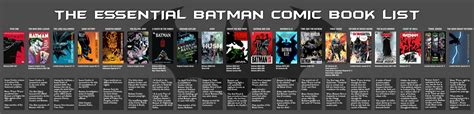
Even for a comic book fan like me, one who spends an inordinate amount of time fixated on the Complete Marvel Universe, reading Batman is almost always a good decision. I’ll answer that here in a relatively expedient manner. Note, that Batman made his comic book debut more than 75 years ago. I won’t mention every comic he’s been in since then, and trying to read all of them would be an intimidating (if noble) life goal. If you want just the best of the best, I’ve listed my favorite Batman stories below.
Batman: The Golden Age Omnibus Vol. Let me be clear: You certainly don’t have to jump back to the 1940’s to start reading Batman comics. The first Golden Age Omnibus is a relatively easy to find, fair-priced (around $40) introduction to Batman’s true beginnings.
Batman: The Golden Age Omnibus Vol. Batman: The Golden Age Omnibus Vol. Batman: The Golden Age Omnibus Vol. Batman: The Golden Age Omnibus Vol. Batman: The Golden Age Omnibus Vol. Batman: The Golden Age Omnibus Vol. Batman: The Golden Age Omnibus Vol. Batman: The Golden Age Omnibus Vol.
Batman & Superman: World’s Finest - The Silver Age Vol. Batman & Superman in World’s Finest: The Silver Age Vol. Batman & Superman in World’s Finest: The Silver Age Omnibus Vol. Batman: The Brave and the Bold: The Bronze Age Omnibus Vol. Batman: The Brave and the Bold: The Bronze Age Omnibus Vol. Batman: The Brave and the Bold: The Bronze Age Omnibus Vol.
Batman: Illustrated by Neal Adams Vol. A number of the comics collected in the Neal Adams illustrations are cover work he did. Batman: Illustrated by Neal Adams Vol. Tales of the Demon marks a more immediate introduction to Rah’s Al Ghul and Talia Al Ghul, and features the creative pairing of Denny O’Neil and Neal Adams. Immeasurably influential late 70’s run on Batman from storytellers Steve Englehardt, Marshall Rogers, and Terry Austin. Tales of the Batman: Don Newton Vol. Tales of the Batman: Gerry Conway Vol. Tales of the Batman: Gerry Conway Vol. Tales of the Batman: Gene Colan Vol.
Batman: Year One is the 1986 graphic novel from Frank Miller and David Mazzucchelli. Batman becomes addicted to venom, the same substance that gives Bane his strength. Collects: Batman: Legends of the Dark Knight Halloweeen Special #1, Batman: Madness - A Legend of the Dark Knight Halloween Special. The Long Halloween is one of two 12 issue graphic novels from the creative team of Jeph Loeb & Tim Sale, where each chapter represents one month in the calendar year. I’d reiterate that these books were actually published in the 1990’s, but they deal (excellently) with Batman’s early days, as well as District Attorney Harvey Dent.
Batman & the Outsiders Vol. Batman and the Outsiders Vol. Legends of The Dark Knight: Norm Breyfogle Vol. The Killing Joke is the increasingly controversial graphic novel from Alan Moore and Brian Bolland. Batman: The Caped Crusader Vol. Now known as the beginning of the fantastic Arkham video games, Arkham Asylum is also a beautifully haunting (and immensely popular) graphic novel from Grant Morrison and Dave McKean. Batman: Knightfall, Vol. Iconic and satisfying Bat-event, as Bane seeks to break the bat. Batman: Knightfall, Vol. Batman: Knightfall, Vol. Batman by Doug Moench & Kelley Jones, Vol. Batman by Doug Moench & Kelley Jones Vol.
You certainly don’t need to read Grant Morrison and Howard Porter’s late 90’s JLA as part of your Batman experience, but the first story is a great showcase for Batman, and goes a long way to defining the character’s relation to the Justice League and the DC Universe at large. Batman Adventures Vol. Batman Adventures Vol. Batman Adventures Vol. Batman Adventures Vol. Batman & Robin Adventures Vol. Batman & Robin Adventures Vol. Batman & Robin Adventures Vol.
Gotham City is rocked by a deadly earthquake, sending the city into total chaos. To make matters worth, President Luthor annexes Gotham from the rest of the United States, leaving the city helpless. Batman: Road to No Man’s Land Vol. Batman: Road to No Man’s Land Vol. Batman: No Man’s Land, Vol. Batman: No Man’s Land, Vol. Batman: No Man’s Land, Vol. Batman: No Man’s Land, Vol. Batman: No Man’s Land, Vol. Evolution and Officer Down are essentially No Man’s Land: Aftermath, as the players adjust to New Gotham. An early glimpse at Ed Brubaker’s skills as a crime novelist. Bruce Wayne is discovered with the body of a wealthy heiress in his arms,, and now the entire Bat family must work to secure his freedom. Batman: Bruce Wayne Fugitive, Vol. Batman: Bruce Wayne Fugitive, Vol. Batman: Bruce Wayne Fugitive, Vol.
This story almost exclusively focuses on the GCPD with only an appearance or two by Batman. Imagine HBO’S The Wire set in Gotham City, only the fight is against super criminals. Watching cops go up against the likes of Mister Freeze and the Joker is as compelling as it gets in comics. Hush serves as a fantastic jumping-on point for new readers who just want to get into modern day Batman without doing homework on all the versions that came before. It introduces all the major players and elements while still delivering a satisfying mystery for existing fans to follow along. At the end of it, pretty much every character is left with some new narrative force. President Luthor declares Batman and Superman the titular “public enemies.” Watch two of DC’s most iconic superheroes outwit and outfight everyone else on the block as they make a run for the White House.
One of the most popular and controversial stories in the entire DCU, this is largely outside the scope of Batman. Judd Winick and Doug Mahnke team-up for one of the better Batman turning points of all time. You really don’t need to read Infinite Crisis as part of a Batman guide. I list it here primarily because it’s the mid-way point for the entire DC Universe in the 2000’s, and because Gotham Central, Book 4 features an Infinite Crisis tie-in. Please note that the titles below that feature issues written by Grant Morrison during his extended run on the Dark Knight are italicized and bolded like so. Not a part of Morrison’s run. Batman by Grant Morrison Omnibus Vol. Final Crisis is genuinely the most difficult superhero universe comic I have ever attempted to read, although at the time I was not nearly as well-versed in the DC Universe. Reader beware! Nonetheless, it’s Morrison’s Crisis event, and sets us up for the next stage of Batman! Collects: Gotham Gazette: Batman Dead? #1, Batman: Battle for the Cowl #1-3, and Gotham Gazette: Batman Alive? Batman: Streets of Gotham, Vol. Collects: Detective Comics (Vol. 1) #852, Batman (Vol. Batman: Streets of Gotham - Vol. Collects: Batman: Battle for the Cowl: Arkham Asylum; Batman: Arkham Reborn [Mini-series, 3 issues]; Detective Comics (Vol. Batman by Grant Morrison Omnibus Vol. Batman and Robin, Vol. Batman and Robin, Vol. 2: Batman vs. The particulars of “Time and the Batman”get quite timey-wimey. A number of 1-shots. Batman and Robin, Vol. Batman: Streets of Gotham Vol. Batman by Grant Morrison Omnibus Vol. Batman, Incorporated- Vol. A mad bomber with a centuries old grudge is out to level Gotham city. Consider this the ceremonial passing of the torch from the Grant Morrison era to the Scott Snyder Batman era.
Dark Nights Metal is an essential Batman crossover, as evil Batmen descent onto Earth. It serves as a continuation of ideas set up throughout the New 52 Batman Run by Scott Snyder and adds dangerous new characters to Batman’s list of enemies including the iconic Batman Who Laughs. Batman Vol. The controversial “Wedding” story. Catwoman Vol. Batman: Detective Comics Vol. Batman Vol. Batman: Detective Comics Vol. Batman Vol. Batman Vol. Heroes in Crisis is written by Tom King who’s also writing Batman. The collection includes a couple of other Heroes in Crisis Tie-ins, but the price is the only story you need to read for Batman. Batman: Detective Comics Vol. Batman Vol. Batman Vol. Batman/Superman Vol. Batman: Detective Comics Vol. Batman: Detective Comics Vol. Batman Vol. Technically this was published as a Black Label book a couple years after King’s run on Batman ended, but it’s clearly a coda to the planned 100 issue run. Batman: Detective Comics Vol. Cold Vengeance is part of DC’s Year of the Villain Event. Though initially intended to be a ground breaking event, the effect of Doomsday Clock was dramatically reduced. James Tynions run is broken into two parts, the pre-Infinite Frontier part which was intended to be his entire run initially with it ending with Joker War. However, fan reception and a major editorial shift resulted in him getting to become the lead writer on Batman for Infinite Frontier. Batman Vol. Dark Designs leads directly into Joker War. Batman: Detective Comics Vol. Collects: Batman: Pennyworth R.I.P. Batman Vol. Batman Vol. Detective Comics Vol.
Death Metal wraps up Rebirth and sets up Infinite Frontier. It concludes the Batman Who Laughs storyline and brings back the evil Batman idea of Dark Nights: Metal. Infinite Frontier Batman begins a little confusing as there’s an event between Rebirth and Infinite Frontier that does a lot of teasing called Future State. Future State teases a possible future that Gotham could face and a very powerful group that will change Gotham forever called the Magistrate. The Batman Family is focused heavily on the future consequences of the election of Mayor Nakano in Detective Comics Vol. 6 (Detective Comics #1028-1033) as the Magistrate comes into power. The world is very fleshed out and introduces major storylines like The Next Batman. Multiple writers including Stephanie Phillips (Harley Quinn), Gene Luen Yang (Batman/Superman), and Mariko Tamaki (Dark Detective) wrote books that tease the upcoming direction of their Infinite Frontier stories. Every book can be read in any order, but I believe this order will maximize enjoyment of the event. Future State Batman is full of little teases that make the universe feel more full if you notice how the books connect. After Future State, Infinite Frontier is here and it begins with a very important one-shot that sets up the Bat-family stories. Batman Vol. Collects: Batman (vol. Batman: Detective Comics Vol. Batman: Urban Legends Vol. Batman/Superman Vol. Batman Vol. Batman: Detective Comics Vol. Batman: Urban Legends Vol. Batman: Urban Legends Vol. Batman: Urban Legends Vol. Batman: Urban Legends Vol. I am Batman Vol. Batman/Superman Vol. Robin Vol. Batman Vol. Collects: Batman (vol. Batman: Detective Comics Vol. Batman/Superman Vol. I Am Batman Vol. Robin Vol. Batman: Detective Comics Vol. Batman: Urban Legends Vol. Batman: Urban Legends Vol. I Am Batman Vol. Batman/Superman: World’s Finest Vol. Batman Vs. Collects: Batman Vs. Batman Vol. Detective Comics Vol. The Ram V era of Detective Comics begins right here, with one of my favorite recent superhero runs, and a favorite comic book of 2024. Ram’s Detective run really keeps to itself as far as continuity is concerned, and won’t overlap much with what’s happening in Zdarsky’s Batman or elsewhere. This means you can really just read Detective Comics straight through - which I would recommend you do! Batman/Superman: World’s Finest Vol. Batman Vol. Collects: Batman (vol. Detective Comics Vol. Detective Comics Vol. Collects: Batman (vol. 3) #137-138, Catwoman (vol. Batman: The Brave and the Bold Vol. Batman: The Brave and the Bold Vol. Batman and Robin Vol. Batman/Superman: World’s Finest Vol. Detective Comics Vol. Batman Vol. Collects: Batman (vol. Batman and Robin Vol. Batman/Superman: World’s Finest Vol. Detective Comics Vol. Batman Vol. Collects: Batman (vol. Batman / Superman: World’s Finest Vol. Batman Vol. Batman: Detective Comics Vol. Batman and Robin Vol.
Not long before he redefined Batman’s origins with Year One, Frank Miller was reshaping the graphic novel medium with The Dark Knight Returns. Miller returned to The Dark Knight about 15 years later, and well, let’s just say it’s far less of a unanimous celebration. DC Comics/Dark Horse: Batman vs. Collects: BATMAN VS. Collects: BATMAN/ALIENS #1-2, BATMAN/ALIENS II #1-3, SUPERMAN/BATMAN VS. A kind of companion piece to Batman vs. Predator, this book collects a series of stories where Batman, Superman, and WildC.A.T.S. must face-off against the Xenomorphs. Collects: Batman/Judge Dredd: Judgment On Gotham, Batman/Judge Dredd: Vendetta In Gotham, Batman/Judge Dredd: The Ultimate Riddle, Batman/Judge Dredd: Die Laughing #1-2 and Lobo/Judge Dredd: Psycho Bikers Vs. Any time that Gotham’s Dark Knight and Megacity 1’s Violent Protector get together, it’s bound to be a violent, absurdist good time. Alan Grant. Simon Bisley. A collection of fun, experimental, and downright absurd Batman stories. An absurd send-up of t... The Batman & Scooby-Doo Mysteries Vol. Batman and Robin Vol. Batman and Robin by Peter J. Batman/Superman: World's Finest Vol. Batman Vol. Batman: Knightfall Omnibus Vol. The Penguin Vol. Batman Vol. Batman by James Tynion IV Omnibus Vol. Batman/Teenage Mutant Ninja Turtles Vol. Batman: Detective Comics Vol. Batman: Justice Buster Vol. Batman: The Golden Age Omnibus Vol. Harley Quinn Vol. Nightwing Vol. Batman: Gotham by Gaslight - The Kryptonian Age Vol. Batman & Robin Vol. 2: Batman vs. Batman Vol. Nightwing Vol. Red Hood and the Outlaws: The New 52 Omnibus Vol. The Batman & Scooby-Doo! Mysteries Vol. Batman: Detective Comics - The New 52 Omnibus Vol. Batman/Superman: World's Finest Vol. Batman: Detective Comics Vol. Catwoman Vol. Nightwing Vol. Batman and Robin Vol. Poison Ivy Vol. Nightwing by Tom Taylor & Bruno Redondo Omnibus Vol. Harley Quinn Vol. Absolute Batman Vol. Batman: Knightfall Omnibus Vol. Batman/Superman: World's Finest Vol. Red Hood: Outlaws Vol. Batgirl: Stephanie Brown Vol. Batgirl Vol. Batman by Tom King Omnibus Vol. Red Hood: Outlaws Vol. DC K.O.: Harley Quinn vs.